The U.S. House of Representatives recently voted in favor of an amendment to remove immunity for pesticide companies from the House Farm Bill. In a decisive, bipartisan vote, House members – with the support of 207 Democrats and 73 Republicans – adopted and passed the amendment (280 to 142) with the larger bill, effectively removing a provision that would have shielded corporate chemical companies from accountability.
The U.S. Senate Agriculture Committee is expected to take action on the Farm Bill in the coming weeks.
There are many voices and groups – AAJ among them – from right to left, joining in broad opposition to immunity for pesticide manufacturers. In addition to our work on the federal level, we continue to closely monitor and support multiple state trial lawyer associations in their pesticide immunity battles.
New release: The state of insurance industry profits
AAJ has released new research revealing the record profits the property-casualty insurance industry continues to make. This is a vital resource to combat tort reform proponents who blame lawsuits for rising insurance premiums.
Our research shows that the property-casualty industry continues to make record profits year after year. These insurers made an unprecedented $405 billion in profits over the last three years – even as they raised prices and pushed for laws to avoid paying more claims.
The insurance industry’s 2025 underwriting income was:
- More than twice as high as any other recorded year.
- Higher than in the previous 20 years combined.
The new tort reform arena
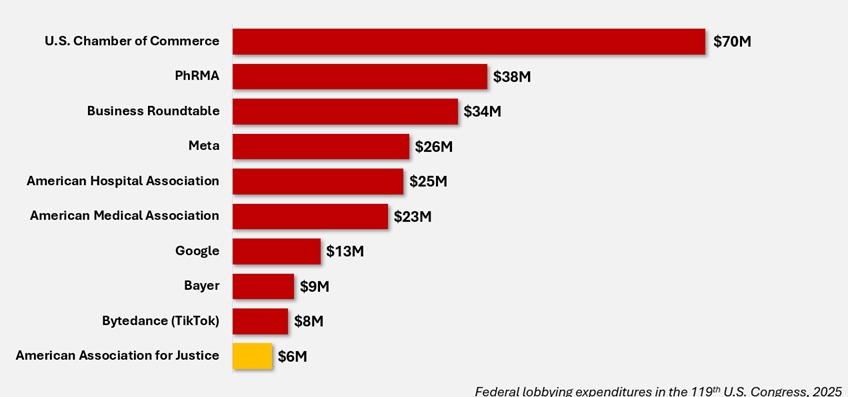
The biggest and newest players entering the tort reform arena are Bayer, Meta, and Uber, and their corporate playbook is daunting.
These corporations have significant funding.
These astronomical war chests enable them to create comprehensive, multi-pronged tort reform campaigns, targeting Capitol Hill, state legislatures, and the courts.
AAJ battles corporations and industries that have lobbyists numbering in the hundreds:
Pharma: 182
U.S. Chamber: 148
Amazon: 123
Alphabet (formerly Google): 110
American Medical Association: 71
Bayer: 53
Legal affairs: Amicus curiae update
Through its amicus curiae program, AAJ protects access to justice and the right to trial by jury by filing briefs that address policy and constitutional issues that directly impact trial lawyers’ practices and the clients they represent.
On April 22, AAJ filed an amicus curiae brief in Ethridge v. Samsung SDI Co., urging the U.S. Supreme Court to clarify that foreign corporations cannot evade personal jurisdiction in state court to answer for injuries caused by their product by taking steps to limit the sale of the product to only certain purchasers and users.
Also on April 22, in Fontaine v. Phillip Morris USA Inc., the Massachusetts Supreme Judicial Court rejected Phillip Morris’s plea that it adopt a different – and higher – standard of proof for the imposition of punitive damages. Massachusetts’s highest court also upheld the $56 million punitive damages award following remittitur from a $1 billion jury award, denying Phillip Morris’s claim that the award was fueled by passion or prejudice on the part of the jury.
In Fontaine, AAJ and the Massachusetts Academy of Trial Lawyers filed a joint amici curiae brief emphasizing the essential role that punitive damages, and the juries that award them, play in deterring reprehensible corporate misconduct.
Legal affairs: Federal rules update
AAJ closely monitors proposed amendments to the rules of court procedure (Federal Rules of Civil Procedure, Federal Rules of Appellate Procedure, Federal Rules of Evidence, and others) governed by the Judicial Conference of the United States. Many states use the federal rules as a guide for their own state rules.
AAJ works to ensure that plaintiff lawyers are represented by advocating for rules that promote justice and are fair, balanced, and efficient.
On May 7, the Advisory Committee on Evidence held its spring meeting in Washington, D.C., and took the following actions:
Voted to table the proposed evidence rule on FRE 707 on Machine-Generated Evidence.
It is looking at revisions that would go to public comment in August 2027.
It will hold a fall mini-conference to discuss rule drafting.
AAJ, its members, and members of the defense bar all provided negative feedback on FRE 707, contributing to it being tabled.
The Advisory Committee also voted to continue working on FRE 901(c) – a proposed rule of authentication to address the problem of deepfakes. The committee would like to move this proposed amendment to public comment at the same time as FRE 707.
The Evidence Committee approved two rule amendments for the 2026 comment period:
FRE 902 on Domestic Public Documents: The proposed amendment would make tribal documents self-authenticating.
FRE 104 on Preliminary Questions: The committee voted to codify a preponderance standard that preliminary questions of fact under Rule 104(a) are to be determined by a preponderance of the evidence.
It would also change conditional relevance under FRE 104(b) to make it clear that evidence is relevant if the trier of fact (court or jury) could reasonably find it to be so.
The court’s preliminary determination of relevance is not limited to proof submitted to it. A court could find evidence relevant under Rule 104(b) by considering the evidence itself, other evidence, and common knowledge and experience.
Fighting Goliath
AAJ will continue to fight attacks from any industry or powerful interests that try to prevent trial lawyers from fighting for justice on behalf of their clients. We will continue collaborating with affiliated trial lawyer associations to resist legislation that limits accountability for corporate wrongdoing in nearly every industry, like trucking, insurance, hospitals, nursing homes, pharmaceuticals, and technology.