The number that decides everything else
Your client came around a curve at night and struck the back of a tractor-trailer that had been sitting unlit in the travel lane for 20 minutes. Liability should be straightforward.
Then the defense report lands. It contains a nighttime video shot at the scene, headlights on, showing the trailer plainly visible at 900 feet. Perception-response distance, braking distance, and the conclusion that your client had room to stop all flow from that number. Now the jury has a figure saying your client could have avoided the collision, and every point of comparative fault comes out of the recovery.
The problem is buried inside the number. The investigator who produced that 900-foot figure read the file first. The investigator knew a trailer had been struck, where it sat, and what it looked like, and may have positioned the surrogate personally before driving out to “discover” it. No one has ever approached that road better informed. That personal sighting is about to be handed to the jury as evidence of what your unsuspecting client could see.
For nearly 90 years, research has shown that an observer who knows something is out there can pick it up at roughly twice the distance of a driver who does not. If 900 feet came from the alerted investigator, every calculation downstream inherits that advantage while the report treats it as your client’s.
The substitution is hard to see because the video appears to confirm it. Jurors already know a collision occurred, and by the time the video plays they know what was hit and where to look. They are watching for the trailer the same way the investigator was. If no one exposes that before the exhibit reaches them, the video does not test the 900-foot number. It reinforces the same advantage that produced it.
The same error appears with pedestrians in dark clothing, unlit construction zones, fallen loads, roadway hazards, and premises cases.
“Visible at 900 feet” is not a measurement of the trailer
It sounds like a physical fact. It is not. At night, visibility depends first on contrast: how much brighter or darker the target is than the background directly behind it. Contrast is calculated from calibrated luminance readings of target and background: the difference between the two, divided by the background. Change the background and you change visibility, even if the target, headlights, and distance stay the same.
There is no single reading that tells you when “the trailer” became visible. Contrast changes across the object. A pedestrian’s torso may stand out against a dark field while the shoes nearly disappear against illuminated pavement. A trailer panel may be obvious against black sky while a wheel vanishes against the road. “Visible at 900 feet” sounds precise, but the physics does not give one visibility number for the whole object.
That is also why “the area was well lit” settles nothing. More light can help or hurt. Headlights may brighten the target against darkness; a streetlight may brighten the background too and shrink the contrast available to the eye. And the video cannot settle the question by appearance alone. Camera settings, processing, and the display all change what the viewer sees.
“Seen” is not the standard. “Recognized” is.
Watch the verb in the report, because one word can hand the defense distance it has not earned. The question is not when something first became detectable in the dark. It is when a driver could recognize it as a hazard. That is when there is a reason to brake and perception-response time begins.
Those are different moments at different distances. A shape at the edge of the headlights may first register only as something being there. It can take additional distance before that shape resolves into a pedestrian, a stopped trailer, or debris in the lane. In daylight the two moments may be nearly simultaneous. At night they separate. An opinion that starts the clock at “first visible” charges that entire distance to your client.
The research separates detection from recognition. In on-road testing, standard visibility measures tracked recognition and bore little relation to first detection. (Janoff, The Relationship Between Small Target Visibility and a Dynamic Measure of Driver Visual Performance (1993) 22 J. Illum. Eng. Soc. 104.) Adrian showed why: as light falls, identifying what something is requires more contrast than merely detecting that something is there. (Adrian, Visibility Levels Under Night-Time Driving Conditions (1987) 16 J. Illum. Eng. Soc. 3.) I have measured the same distinction. In the night-driving simulator I built and ran, detection and recognition were scored separately; recognition required identifying the target, not merely seeing a shape.
The most alerted observer in the case produces the number
A sight distance is never just a fact about a road. It is equally a fact about the observer, and the most important fact about that observer is what was already known before the looking began.
Think of alertedness as a ladder. On the bottom rung is your client, driving normally, unaware anything is ahead. Above is someone who knows a collision occurred; then someone who knows what was hit and where; then someone who has watched the video. Off the top stands the investigator: file read, location known, target known, perhaps placed by hand. No procedure makes that investigator forget it. The only person who ever stood on the bottom rung is your client.
Two field studies, nearly 50 years apart, measured what those rungs are worth. In 1937, General Electric’s headlamp engineers routed 46 drivers who believed they were evaluating beam patterns past a dark-clothed dummy. Once they knew it was there, they saw it from roughly twice as far as on the first unsuspecting pass. Unalerted distance averaged 51% of alerted distance. (Roper & Howard, Seeing with Motor Car Headlamps (1938) 33 Trans. Illum. Eng. Soc. 417, presented Sept. 1937.)
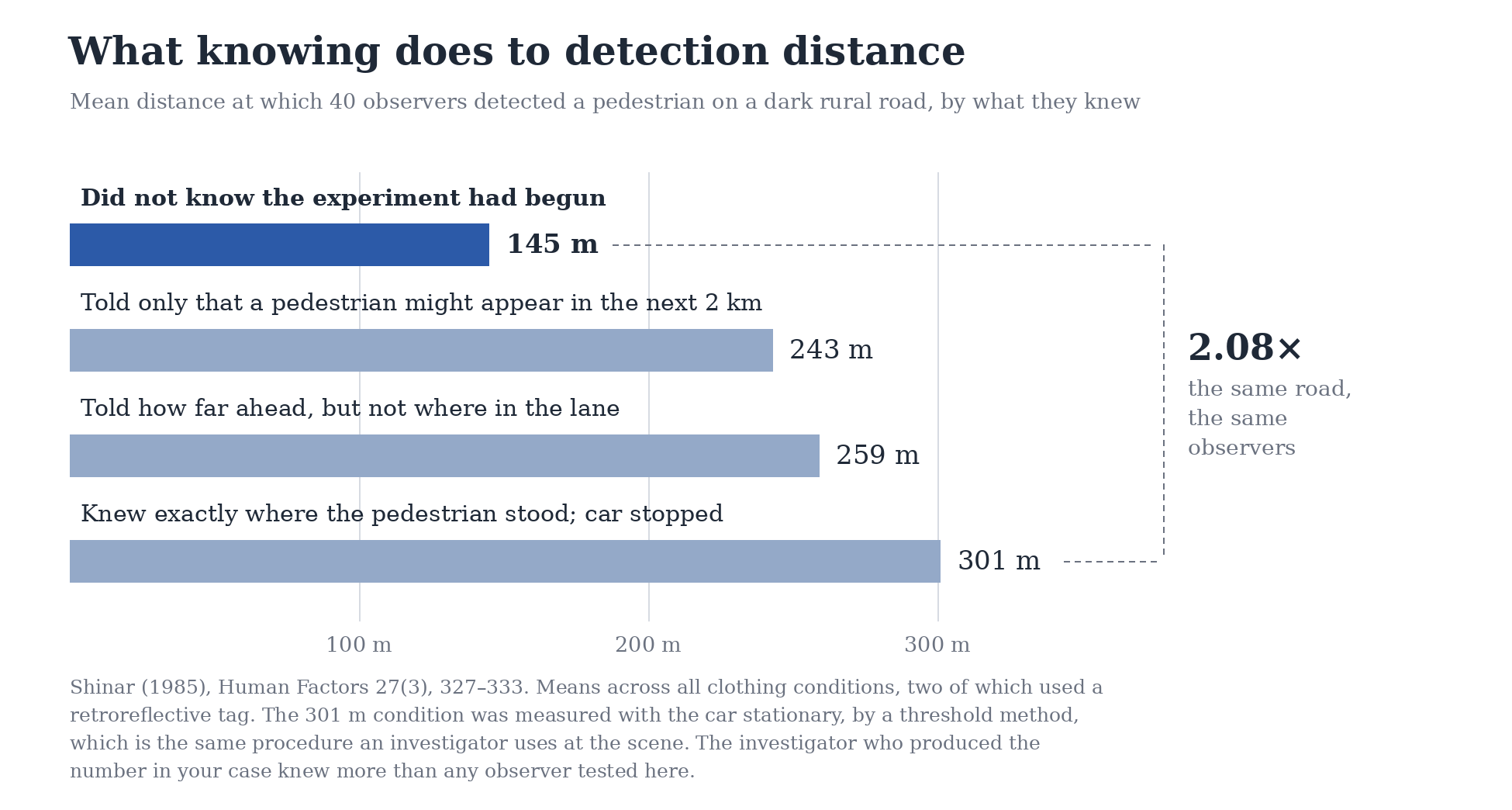
Shinar showed how little information it takes to move an observer up that ladder. In 1985, 40 licensed, vision-screened drivers rode as observers on a deserted rural road. (Shinar, The Effects of Expectancy, Clothing Reflectance, and Detection Criterion on Nighttime Pedestrian Visibility (1985) 27 Hum. Factors 327.) The first pedestrian appeared while subjects thought they were still practicing on road signs. They did not know the experiment had begun, and average detection distance was 145 meters. Then they were told only that a pedestrian might appear somewhere in the next two kilometers. That sentence moved the average to 243 meters, 98 meters bought with a warning your client never got. When observers knew exactly where to look, the average reached 301 meters, 2.08 to 1 against the least-alerted condition.
Look at how that 301 meters was produced, because it is essentially the investigator’s method. The car was stopped. The observer knew exactly where the pedestrian stood and marked the distance at which the figure could just be made out. That is not detection measured during an ordinary approach. It is the farthest point at which someone who already knows what and where can still find the target while looking straight at it, with unlimited time and nothing else to do.
That is how sight-distance testing is often done in reconstruction. The target is placed, the observer backs away until it disappears, comes forward until it reappears, and records the distance. I have watched it done exactly that way. Step for step, it resembles Shinar’s most-alerted condition, which produced more than twice the distance of observers who did not know the pedestrian test had begun. The reconstruction investigator may know even more, having read the crash file and perhaps chosen the location and placed the target.
So, the 900 feet in your case is not a measurement of what your client could see. It is a measurement of what a fully informed observer could find while already knowing the answer. And it cannot be a recognition distance for that investigator, because the investigator recognized the trailer before ever getting in the car.
Two to one is the floor, not the estimate. The 1937 drivers knew they were in some kind of test, and even Shinar’s least-alerted observers had been given a task. That knowledge makes people search harder than an ordinary driver does, narrowing the measured gap. Neither study measured an ordinary driver who suspected nothing at all. Your client did.
The jury becomes the next test subject
Then the video plays and the jurors become observers too, except they are now among the most alerted observers in the building. They know what was hit and where. The exhibit tells them when it is coming. Every replay and every freeze-frame gives them another advantage your client never had.
Even a perfectly calibrated image cannot solve that problem. Calibration can make an image a faithful record of the light at the scene. It cannot make the viewer unsuspecting. Once the jury knows the target is there, the jury cannot tell you when an unwarned driver would first notice and recognize it. That question requires unwarned observers, and a jury never is one.
Hindsight compounds the problem. Once people know an outcome, they judge it more foreseeable than it appeared beforehand, and warning them about hindsight does not reliably fix the effect. (Kamin & Rachlinski, Ex Post ≠ Ex Ante: Determining Liability in Hindsight (1995) 19 Law & Hum. Behav. 89; Giroux et al., Hindsight Bias and Law (2016) 224 Zeitschrift für Psychologie 190.) Hindsight may be unavoidable in court. The alerted-observer error is not. It can be identified and challenged, but only before the video teaches the jury where to look.
Five questions before that number reaches the jury
These are the questions I want answered before a nighttime sight-distance number becomes the foundation for fault, stopping distance, or avoidability. Each forces the expert to expose a different part of the foundation. A bad answer to any one can turn a polished “reconstruction” back into what it may actually be: one alerted observer’s sighting.
1. What did you measure, and with what?
If the expert puts a sight-distance number before the jury, ask where the measurement is. Nighttime visibility is measured, not eyeballed. A defensible opinion starts with luminance readings from the driver’s sightline, target and background recorded separately, at stated distances, with the calibrated instrument identified and conditions logged. (Ising, Pedestrian Visibility in Night-Time Impacts (MEA Forensic, Oct. 1, 2008).) Without those readings, the claimed distance is not a photometric result. It is one alerted observer’s personal sighting, unreproducible and impossible to check.
2. Was the camera checked against the scene? Was the courtroom screen?
An uncalibrated nighttime image is not a measurement of human visibility. Exposure, tone reproduction, processing, lens scatter, and display conditions can change target-to-background relationships. (Ising, supra; see also Krauss et al., SAE Tech. Paper No. 2006-01-1288 (2006); Allin, Ising & King, SAE Tech. Paper No. 2007-01-0718 (2007).) Ask what objective reference ties the image to the scene and the courtroom display to the image. If the footage was adjusted until it matched an investigator’s recollection, the calibration standard is a memory no one else can inspect. A known reference target in frame gives you something objective to test.
3. Who did the looking, and what did they know?
If the sight distance is the investigator’s own observation, two problems arrive together: the observer is at the top of the alertedness ladder, and the sample size is one. Estimating what drivers can see from one investigator’s sighting is like estimating a population’s average height from one basketball player. (Ising, supra.) Training does not erase prior knowledge. The expert usually knows more about the target than anyone else who will ever approach it.
4. Did you correct from alerted to unalerted? By how much, and citing what?
Published analysis has used a factor of 0.51 to convert alerted detection distances toward the unalerted condition, based on Roper and Howard. (Ising & Green, “The Distribution of Visibility Levels at Target Detection in a Modified Adrian/CIE Visibility Model,” Proceedings of the Human Factors and Ergonomics Society Annual Meeting (2009), 53(23), 1796–1800.) There are two defensible routes: use observers who genuinely did not know what was coming, or apply a stated correction with a source and its limitations. No correction is not neutral. It is a factor of 1.0, asserting that the fully informed investigator and your unsuspecting client would see the hazard at the same distance. That is the proposition this literature most directly rejects.
5. Walk me from your readings to your number.
Files often contain a few light readings that never produce the final number. Photometry in the file is not the same as an opinion computed from photometry. Make the expert walk the arithmetic from raw readings to the report’s sight distance. If the trail ends with “that is where I could see it,” the photometry is decoration. The number did not come from the science. The science was added around the number. Your own expert should survive the same question.
Nine hundred feet was never your client’s nine hundred feet
Put back the effects the report left out, one at a time, and the 900-foot number does not survive.
Start with expectancy. Roper and Shinar both found roughly two to one between the most and least alerted observers, so the investigator’s 900 feet is something like 450 for a driver who had no warning, before anything else is considered.
Then the verb. Federal Highway Administration testing recorded detection and recognition in the same drivers on the same pass, and recognition occurred approximately 15% closer. (Fed. Highway Admin., Enhanced Night Visibility Series, Vol. III (Dec. 2005) Rep. No. FHWA-HRT-04-134.) Recognition is what starts the clock, so the distance shrinks again.
Then surprise, which acts on time rather than distance. A driver who is not expecting a hazard takes roughly twice as long to begin braking as one who is expecting it. (Green, How Long Does It Take to Stop? Methodological Analysis of Driver Perception-Brake Times (2000) 2 Transp. Hum. Factors 195.) That means more road traveled before the brakes are touched.
These are three separate effects, and each runs the same direction. Alertedness let the investigator see the trailer sooner. Detection started the clock before recognition. And the report gave your client the response time of a driver who was expecting the hazard. None of those corrections was applied. The report gives the investigator the advantages and sends your client the bill.
Measure the scene, not the investigator
There is another way to test the claim. From measured target and background luminance, target size, and distance, a visibility level can be calculated along the approach. (Adrian, supra.) Published thresholds provide a reference for safe driving and a higher level for recognition. Plot visibility level against distance and the dispute stops being about whose expert says the target looked obvious. The question becomes whether 900 feet clears an objective threshold. If it does not clear even the safe-driving level, the claim fails before alertedness is considered.
That is what a full nighttime reconstruction should look like: scene geometry, photometry at the actual sightlines, documented calculations, and a result another expert can check. It takes more work than driving until the target appears, and more time than a short rebuttal window may allow. Retain early.
Do not let the video go first
Once the jury has seen the target, the jury can never again be an unwarned observer. That makes sequence part of the evidence problem. Let the video go first and you have taught the jury where to look before you get to challenge the method that produced the number.
Do not wait until trial to find out what the number actually is. At deposition, make the expert identify the measurements, observers, alerted-to-unalerted correction, and arithmetic that produced it. If a nighttime video is offered as proof of what the driver could see, challenge its foundation before the jury sees it (in California, at an Evidence Code section 402 hearing). If it comes in, ask the court to limit replays and freeze-framing. Every replay teaches the jury where to look.
Measured, not narrated
A defensible nighttime-visibility opinion can survive those questions because it shows its work. The scene is measured in real units. The target is evaluated against its actual background. Detection is not silently substituted for recognition. Any alerted-to-unalerted correction is identified and sourced. The final distance traces through the calculations to the measurements. And when the question is what an unwarned driver would have perceived, the answer addresses an unwarned observer, not a jury repeatedly watching a known target.
When the other side can show that chain, you have a real scientific dispute. When it cannot, do not let the instruments, video, and technical vocabulary obscure what is underneath them: the personal sighting of the one witness who knew the answer before the test began. A video and a light meter do not transform that sighting into your client’s sight distance.
The investigator stood off the top of the ladder to produce that number. Your client was on the bottom rung.
That is not your client’s sight distance. It never was.
Craig Fries is a forensic scientist and testifying expert specializing in human vision and nighttime visibility, video and image analysis, photogrammetry, shooting reconstruction, and forensic visualization. He began his scientific career conducting NASA-funded research in sensation and perception and later conceived, designed, built, and calibrated the Night Driving Simulation System, an instrument for measuring functional vision under nighttime conditions that was approved for use in FDA protocols and clinical trials. He is one of four named inventors on the U.S. patent for Eye View™, a system for objectively measuring and demonstrating human functional vision. Fries is also an author of peer-reviewed forensic research and has directed more than 2,000 forensic reconstructions in criminal and civil matters for both plaintiff and defense counsel. He is the founder of Evidence Sciences Group.